
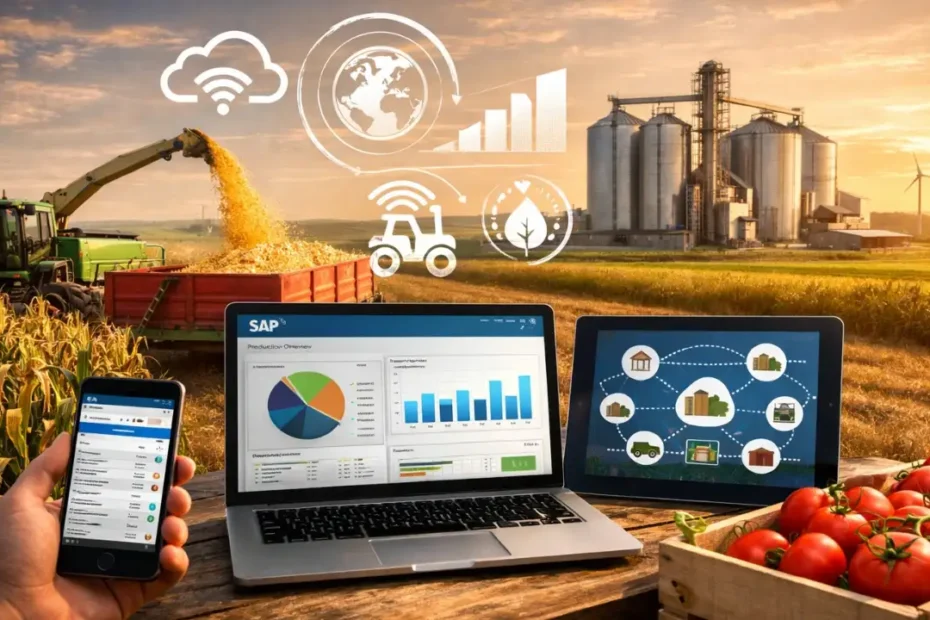
The agroindustry sector is undergoing rapid digital transformation, and SAP Applications for Agroindustry are playing a crucial role in modernizing operations, improving traceability, and increasing profitability. From farm production to distribution and export management, SAP solutions provide integrated tools that help agricultural businesses operate with greater efficiency and transparency.
As global demand for food continues to grow and regulations become more complex, agroindustrial companies need advanced systems that connect every stage of their value chain. SAP technologies deliver real-time visibility, automation, and data-driven decision-making to meet these challenges effectively.
The Digital Transformation of Agroindustry
The agroindustry faces unique operational challenges:
-
Seasonal production cycles
-
Perishable goods management
-
Strict quality and safety regulations
-
Supply chain complexity
-
Volatile market pricing
Traditional management systems often fail to provide full integration between production, inventory, logistics, and finance. SAP applications address these gaps by centralizing data and processes into a unified platform.
By implementing SAP solutions, agroindustrial companies gain better control over operations, reduce waste, and ensure regulatory compliance.
Key Benefits of SAP in Agroindustrial Operations
1. End-to-End Traceability
Traceability is critical in agroindustry. SAP systems allow businesses to track products from raw material sourcing to final delivery. This ensures:
-
Compliance with food safety regulations
-
Faster recall management
-
Improved consumer trust
-
Accurate batch tracking
Real-time monitoring reduces risks and improves accountability across the supply chain.
2. Integrated Supply Chain Management
Agroindustry supply chains are often complex and geographically dispersed. SAP applications integrate:
-
Procurement
-
Production planning
-
Inventory management
-
Logistics
-
Distribution
This integration improves coordination between departments and minimizes operational bottlenecks. Businesses can forecast demand more accurately and optimize stock levels to reduce losses from spoilage.
3. Advanced Production Planning
Seasonality and climate conditions heavily influence agricultural production. SAP solutions enable:
-
Accurate yield forecasting
-
Resource planning (labor, machinery, raw materials)
-
Production scheduling
-
Cost control
With predictive analytics, companies can prepare for fluctuations and adjust strategies proactively.
4. Financial Transparency and Cost Control
Agroindustrial operations involve variable costs such as raw materials, transportation, and storage. SAP applications provide:
-
Real-time financial reporting
-
Cost analysis per batch or production cycle
-
Profitability tracking
-
Budget control
This transparency allows decision-makers to identify inefficiencies and optimize margins.
5. Regulatory Compliance and Quality Management
Food safety and agricultural regulations continue to evolve globally. SAP systems help ensure compliance through:
-
Automated documentation
-
Audit-ready reporting
-
Quality inspections
-
Certification tracking
Digital documentation reduces administrative workload and minimizes the risk of penalties.
Sustainability and Environmental Management
Sustainability has become a strategic priority in agroindustry. Consumers and regulators increasingly demand responsible practices.
SAP applications support sustainability initiatives by enabling:
-
Monitoring of resource consumption (water, energy, fertilizers)
-
Carbon footprint tracking
-
Waste reduction strategies
-
Sustainable sourcing management
By analyzing environmental data, companies can implement greener processes while maintaining profitability.
Improving Decision-Making with Real-Time Data
One of the strongest advantages of SAP solutions is access to real-time analytics. Agroindustrial managers can:
-
Monitor production performance
-
Analyze supply chain efficiency
-
Track financial indicators
-
Identify trends and risks
Data-driven insights improve strategic planning and reduce reliance on guesswork.
Enhancing Collaboration Across Departments
In many agroindustrial businesses, departments operate in silos. SAP applications unify:
-
Operations
-
Finance
-
Sales
-
Procurement
-
Quality control
A centralized system improves communication, reduces errors, and accelerates workflows. Teams work with shared, accurate data, enhancing overall productivity.
Scalability for Growing Agroindustrial Companies
As agroindustry businesses expand into new markets or increase production capacity, they require scalable systems.
SAP platforms are designed to grow alongside the company. Whether managing multiple farms, processing plants, or distribution centers, the system can adapt to evolving operational needs.
This scalability ensures long-term digital stability and protects technological investment.
Competitive Advantage in a Global Market
Global competition in agroindustry is intense. Companies that leverage advanced digital tools gain significant advantages:
-
Faster response to market changes
-
Better cost management
-
Improved product quality
-
Stronger customer relationships
SAP applications help agroindustrial businesses remain agile and competitive in a dynamic marketplace.
Conclusion
The agroindustry sector is rapidly evolving, and digital transformation is no longer optional. SAP applications provide the integration, automation, and real-time insights necessary to optimize production, ensure traceability, and maintain regulatory compliance.
By implementing SAP solutions, agroindustrial companies can enhance operational efficiency, improve sustainability, and secure long-term growth in an increasingly competitive global environment.
For more informative articles, visit our site daily.